Joyeye
It was in the early years of the 2000’s…..let’s say 2005, but it could have been later actually, as late as 2010. I was on a crowded Victoria line tube going home. Standing in front of me was a young Japanese man holding his phone up to the carriage crammed with people. But on the screen, instead of the photo I expected to see, there was a drawing of the scene. Admittedly not a very good drawing but a drawing none the less. “Excuse me,” I said, “How do you do that?” “It’s an App.” he replied. “What’s an App?” I asked. I didn’t really understand his answer. We had arrived at Victoria and everyone was getting out. “What’s it called?” I said, before he disappeared down the platform. “Joyeye.” was his intriguing answer.
It was not intriguing for long. I enquired of friends, telling them about my encounter. They told me about the Google Play Store. And there was Joyeye! Now, this was before smart phones existed as they do today. I had a little primitive Nokia but it had a camera of sorts, and a USB cable and somehow I could import Joyeye onto it. Also, I could store photos from my digital camera onto my laptop and move them onto my phone and thence to Joyeye. I had my first App! And I have to say it has been my only App as far as image production is concerned.
I enjoyed its simplicity, and its primitiveness. Not a hint of Photoshop, no skill required. I used Joyeye for many years: sometimes in the background of my work and sometimes foregrounded as the sole means of production.
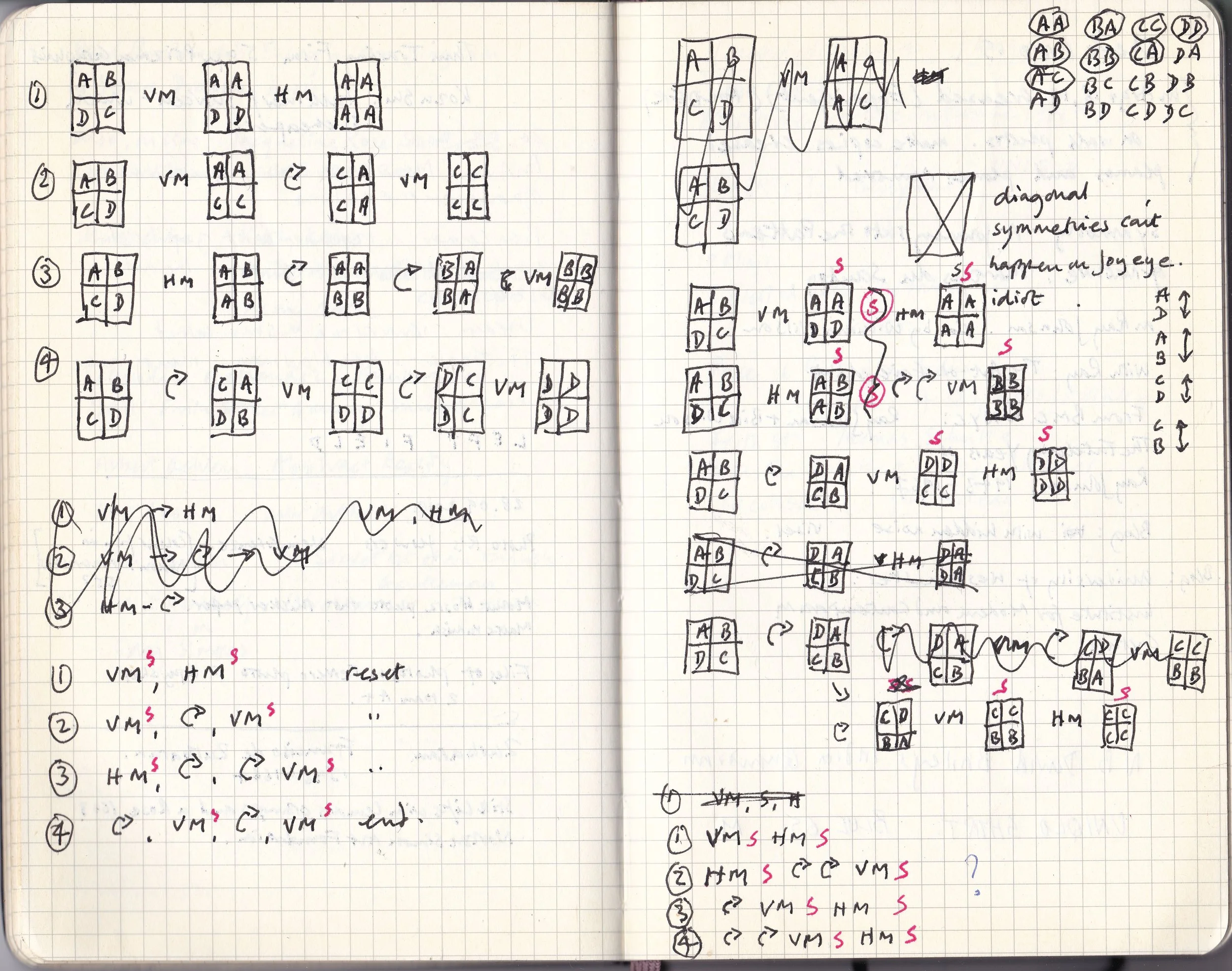
Among the features of Joyeye are the vertical and horizontal mirrors which enable symmetrical drawings to be produced instantly of part of a selected image. In this way in 2020 I made symmetrical images from each quarter of each of the 52 Field Note drawings. These became the large pieces titled ‘Field Notes - The Complete Symmetries’ and ‘Field Notes - The Dark Symmetries’. The undated notebook page (see below). I had used the same procedure many years earlier for making ‘Argo’, a series of 40 drawings made in the Pelion in Greece in 2009 and extended in London in 2012 by using Joyeye to make symmetrical images derived from the original drawings.
Joyeye has been an unlikely companion - a plaything repurposed. Amongst other tricks in its box is ‘Quad Four’, by means of which the image can be divided and shifted upward or sideways in small increments. There are also ‘Spherical Distortions’ and ‘Pixelation’ which are self-evident, as well as its ability to cast texture and colour onto the image in totally unexpected ways.
The story of Joyeye has a sad end. It is no longer to be found online and it’s old version is stuck forever in my tiny 20 year old Nokia. I shan’t use Joyeye again, but I am grateful for the hours that I have spent playing with it at the intersection of the analogue and the digital. Maybe its disappearance is a blessing in disguise.